Fruit, Apollo 11, and 4 Dimensions
Fruit, Apollo 11, and 4 Dimensions
Beta Test Physics Toolbox AR Field Visualizer

Our Android app for displaying magnetic fields is now ready for testing! Visualize the Earth's background field (and be prepared for a few possible conceptual surprises) or check out field lines around a bar magnet.
Stepping into a New Dimension: Using Quaternions to See the Invisible
Our recent work has looked at the display of rotated magnetic field sensors in space. Scientists, engineers, and mathematicians of all types have been challenged by three dimensional rotation for a long time. Apollo 11’s astronaut Collins was plagued by the mechanical limitations of his capsule’s inertial measurement unit (similar to the much smaller sensors that can be found in smartphones to measure rotation) while he tried to maneuver while in orbit during the first Moon landing.
The most frequently used mathematical solution for representing three dimensional rotation without running into a problem called "gimbal lock" is to use a 4D representation of the world knows as quaternions. Quaternions use a projected mathematical system that takes 4D information and places it onto a 3D world. (The idea is allegorical to taking a 3D orange peel and flatting it onto a 2D plane)

If you want to know more about quaternions, read the blog, and see some very nifty videos that focus on math and how the smartphone problems we have encountered in our work is not unlike that experienced by astronaut Mike Collins just about 50 years ago.
Learn more about the power of quaternions in the video below.
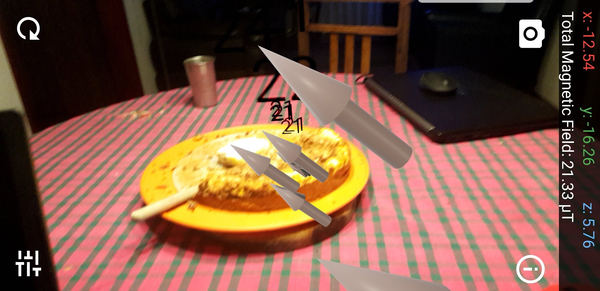
What do this 3D visualizations get us? For one thing, this screen capture from our colleague, Arturo Martí, in Uruguay demonstrates that the Earth's background field points "upward" in the Southern hemisphere.
Clever Lab Ideas
Don't forget to check out our Lessons Page for nearly 50 ideas!
Ideas in Pictures
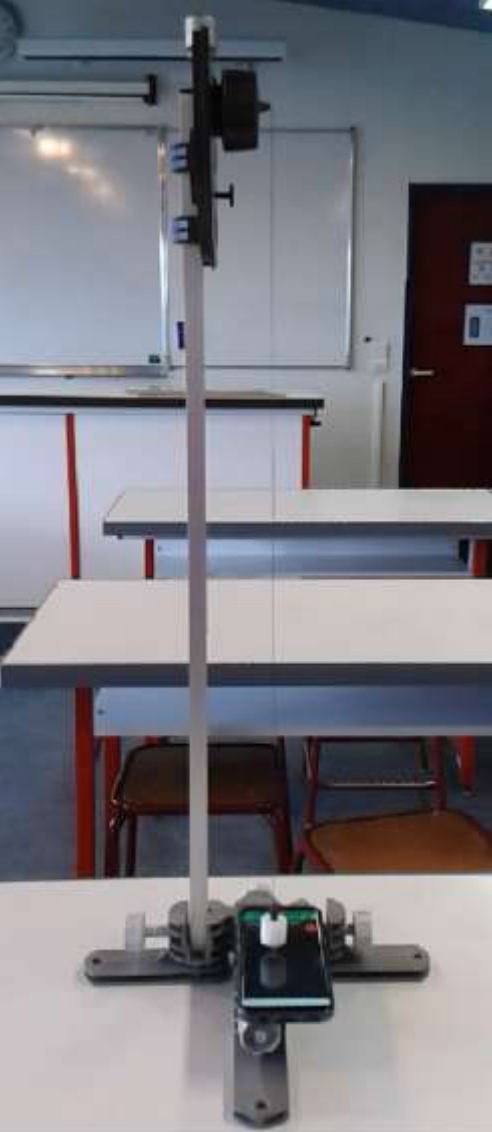
This French-language presentation provides easily-understandable visuals displaying 17 different ideas for teaching STEM with smartphones (using multiple apps). These ideas include the following:
- Analyzing emission spectra
- Using the camera as a microscope
- Measuring the inclination of the sun
- Analyzing motion through video
- Visualizing molecular models in AR
- Measuring the period of a pendulum
- Measuring acceleration due to gravity
- Measuring the period of a pendulum
- Determining the height of an elevator using changes in motion
- Determining the characteristics of sound
- Determining a distance by echolocation
- Determining a speed by Doppler effect
- Measuring the speed of a rolling object
- Measuring the speed of rotation with a turntable
- Finding the accelerometer in a smartphone
- Measuring ambient pressure
- Visualizing accelerometer motions
- ...and more!
Physics Toolbox Around the Web
Physics Toolbox was installed on smartphones and used to model different types of falling scenarios (forward, backward, left, right) in order to determine if it is possible to use smartphone measures to determine if the user has fallen.

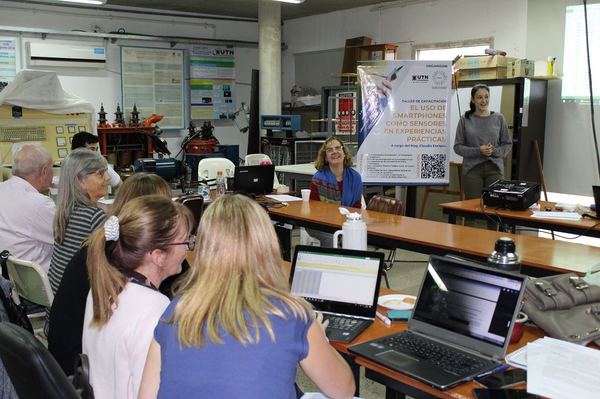
The National Technological University of Argentina recently put on a teacher workshop for the integration of smartphones into science learning using Physics Toolbox. See more in their news clipping.
Have Physics Toolbox Apps been useful to you? We'd love to get your feedback on this quick 5-minute survey.
Have a great story to share about how you are using Physics Toolbox Apps? We'd love to feature you and your ideas in our newsletter or on our website! Drop us a message at any time to share your story.
Previous Newsletter Editions