Contextualizing Technology
Contextualizing Technology
A Full Magnetism Inquiry Sequence w/Smartphones
New Blog Posting
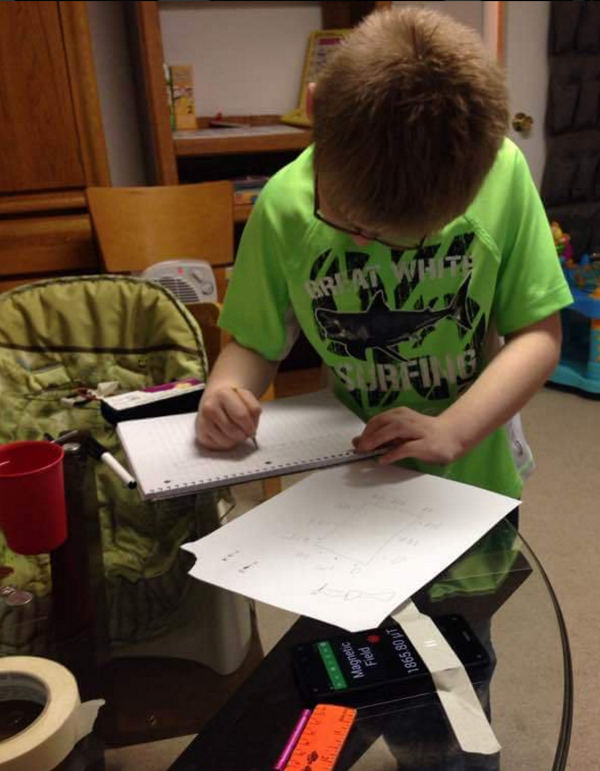
Teachers will never be replaced by technology, in part, because science is a highly collaborative endeavor. Even children learning "alone" typically need a facilitator to help them gauge their own discourse as they build and refine their mental models about the world. Recently, my father and physics teacher educator, Carl Wenning, had an opportunity to work with my nephew as he learned about magnetic fields in the context of his homeschooling studies. What resulted was a learning sequence that students, educators, and curious adults who use smartphone sensors in their teaching might find useful...
Smartphone Physics Workshop at the American Association of Physics Teachers
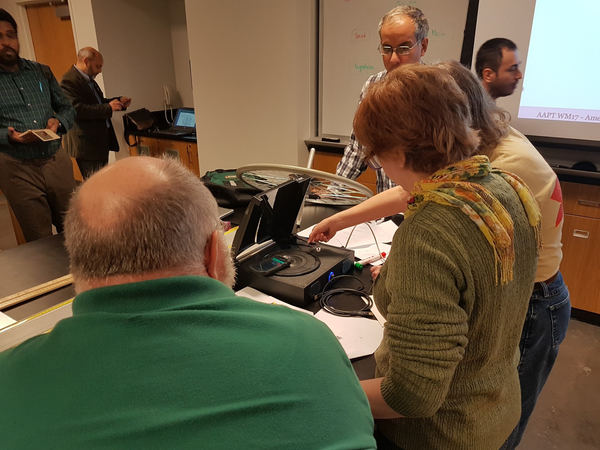
Arturo Marti and Martin Monteiro of Uruguay both made the trek up to Atlanta, Georgia, to give a workshop with us at the American Association of Physics Teachers one week ago. We were delighted to have about 27 high school and college professors at our workshop.

Workshop attendees performed 10+ experiments, including some new ones we don't yet have on our website. Keep an eye open for upcoming additions to our lesson ideas and more developed lesson templates.
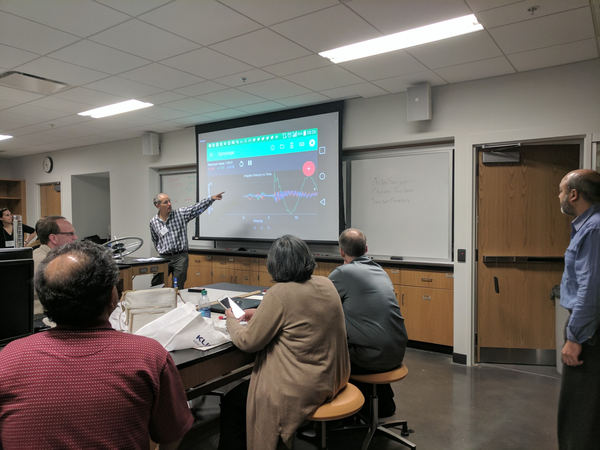
Arturo and Martin are perhaps the most prolific writers regarding the use of smartphones in science teaching. Check out Martin's listing of their works (and others') at his blog.
Visit Martin's Smarter Physics Blogspot
Quck Lab Idea #1: Free Fall Physics
Drop your phone!
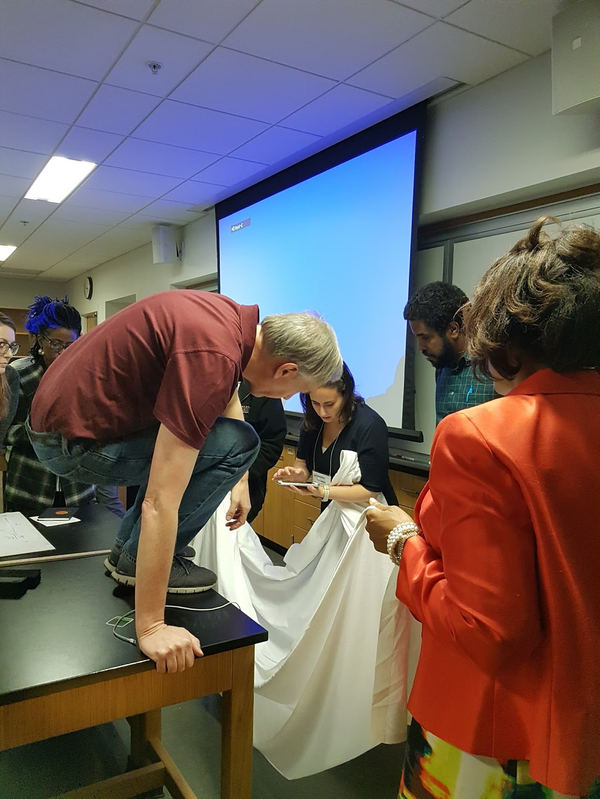
Using a bed sheet, determine the acceleration due to gravity using your smartphone. While in Physics Toolbox's "Linear Acceleration" mode, first note the acceleration of the phone while at rest with respect to your local frame of reference. (In Physics Toolbox, this should read "0, 0, 0." If this is not the case, then go into settings and enable Calibration). Holding the phone about 2 meters above the bedsheet, carefully drop your smartphone into the middle of the sheet, ensuring that the phone did not rotate during its fall. Looking at the data, you should note a clear dip to +/-9.8 m/s/s (depending upon how it was initially suspended!), followed by an even larger acceleration in the opposite direction when the phone collided with the sheet.
Quick Lab Idea #2: Resonance and Speed of Sound
Visualize sound in multiple ways!
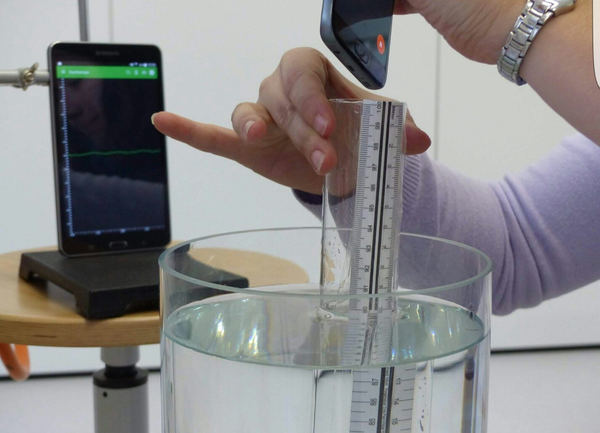
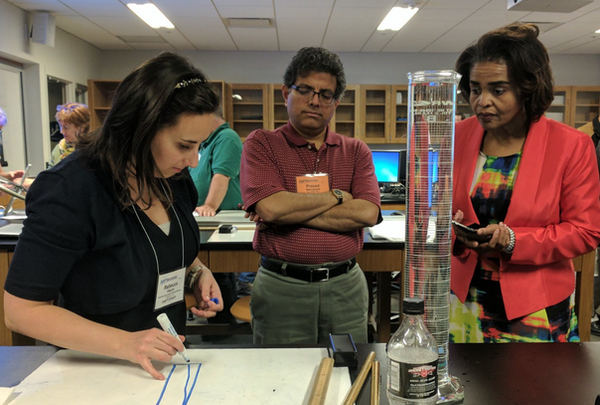
Enhance the classic speed of sound in air using a resonating tube activity by using Physics Toolbox Tone Generator as a modifiable tuning fork. As an added plus, consider visualizing the change in wave amplitude during resonance using the Oscilloscope Mode.
Top photo credited to Oveges Diaklabor of Hungary.
Quick Lab Idea #3: Series and Parallel Springs
Deriving Hooke's Law in a different way
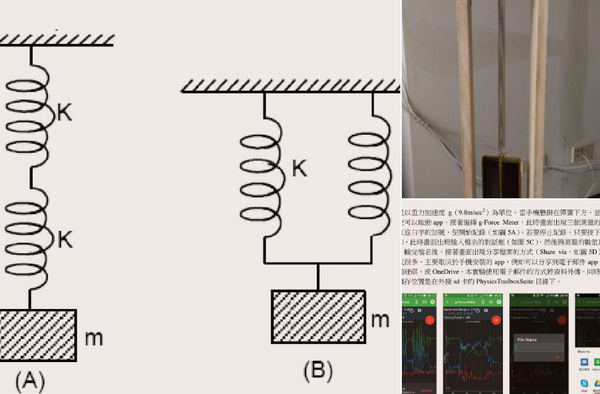
Although you might not be able to read this article from Chinese Physics Education, it is worth skimming just to look at the pictures. While many of us will teach students how to derive the spring constant, k, as a function of extension of a single spring, it is also possible to do so by observing oscillations of the spring.
For an added benefit, and to produce something of a discrepant event for many students, consider having them also look at oscillating springs in series and in parallel!
Quick Lab Idea #4: Data Collection and Display
Learning fundamental graphing skills from real data
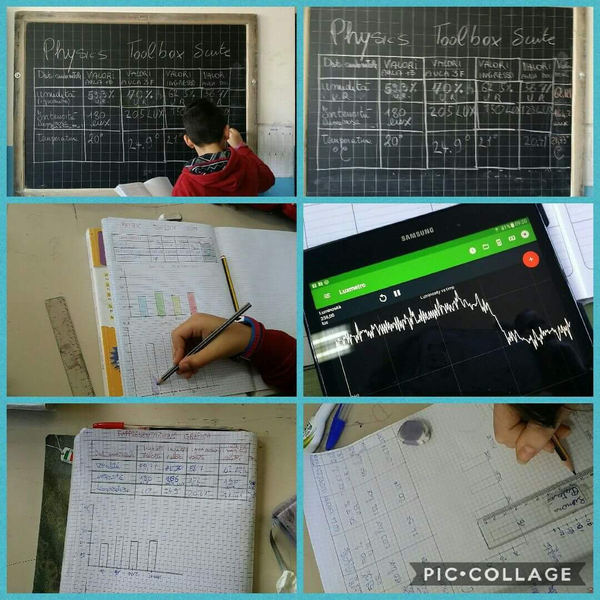
While we usually develop for high school / college education and adult users, occasionally we find people who use Physics Toolbox for younger students. When developing graphing skills, students are frequently only presented with mock data of precise values.
Thanks to Grazia Paladino of Italy for sharing this collage of a child using sensors to practice graphing skills by using real atmospheric data around the school (relative humidity, light intensity, and temperature). Not only do students learn fundamentals about data display (tables, bar charts, titles, units, axes, etc.), but they must also make sense of messy data by estimating averages from mobile sensor data.
Have Physics Toolbox Apps been useful to you? We'd love to get your feedback on this quick 5-minute survey.
Have a great story to share about how you are using Physics Toolbox Apps? We'd love to feature you and your ideas in our newsletter or on our website! Drop us a message at any time to share your story.
Previous Newsletter Editions