Sensors for Informal Ed
Sensors for Informal Ed
APS Mini Grant Awarded to Physics Toolbox
for Informal Education & Outreach
Vieyra Software has been awarded one of a handful of educational outreach "Mini Grants" by the American Physical Society, supported by an award from the National Science Foundation, PHY #1404843.
Funding from this grant will allow for the development of Physics Toolbox Play, a free Android app that will include up to 10 sensor-based, data-validated physical challenges. It is being designed so that children ages 8-12 and their families can (1) interact with the environment through sensors, (2) complete a series of challenges to demonstrate their understanding of sensors, (3) correctly answer conceptual questions about physical data, and (4) get exposed to career information about the use of sensors in the workforce.
Please send a note to support@vieyrasoftware.net if you would like to be a beta-tester for this app.
The grant funding will also allow for a series of sponsored family science experiences in the Alexandria, VA public library system and dissemination through the American Library Association.
A multi-national team will support this endeavor, including Kyle Forinash and Diana Price of the U.S., Martin Monteiro, Cecilia Stari, Cecilia Cabeza, and Arturo Marti of Uruguay, Jean-Luc Richter of France, Giovanni Pezzi of Italy, Manuel Gonzalez of Spain, and Ann-Marie Pendrill of Sweden.
New Physics Toolbox Team Member
Benjamin Xu

To support the development of Physics Toolbox Play, we've been lucky enough to be joined by Benjamin Xu. Ben recently finished his freshman year at the University of Texas - Austin as a computer science major, and has already proven himself to be a brilliant app developer. Learn more about Ben in a few days when we add his profile to the "About Us" section of our website.
More Features
Available on Physics Toolbox Sensor Suite & Pro
GPS Speed Recording
Updates have been made to both Physics Toolbox Sensor Suite and Sensor Suite Pro versions to allow speed recording for GPS data. To access this functionality, select the Multi Record mode and check "GPS." Doing so before recording will collect latitude, longitude, and speed (in m/s) data. (Why isn't GPS speed recording available in the GPS mode, and only in Multi Record mode? GPS mode is programmed to save files in .kml format (map-saving), and does not support speed recording.
File Saving Dialogue
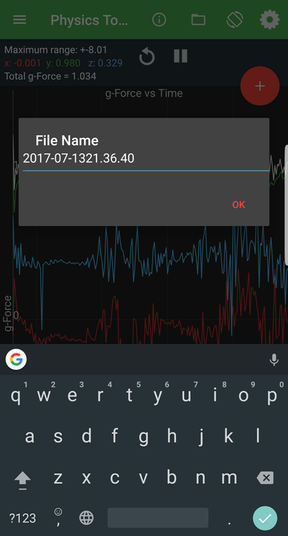
To improve file saving, both Sensor Suite and Pro now provide a default name for saved files using the date and time of the file recording, which can be modified by the user before saving, if desired.
Low Pass Filter
In addition to the moving average and the Kalman filter, Physics Toolbox Sensor Suite Pro now includes the option to apply a low pass filter. The low pass filter is useful for identifying low frequency patterns in data. This filter works by excluding high frequency patterns. The video below describes how RC (resistor-capacitor) circuits can be used to attenuate high frequency signals, and gives a good analogy for how the data is being modified. Likewise, low pass filters can be constructed for acoustical systems by placing physical barriers that reflect high frequency sounds but transmit low frequency sounds. In optics, physical filters can be used to allow only high frequency wavelength through (such as a violet filter that allows violet light through, but reflects and/or absorbs lower frequencies of light such as red and orange colors).
Quick Lab Ideas
Oscillation in Two Ways
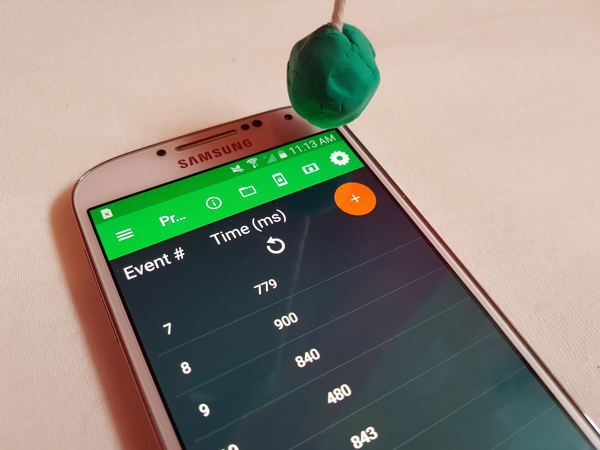
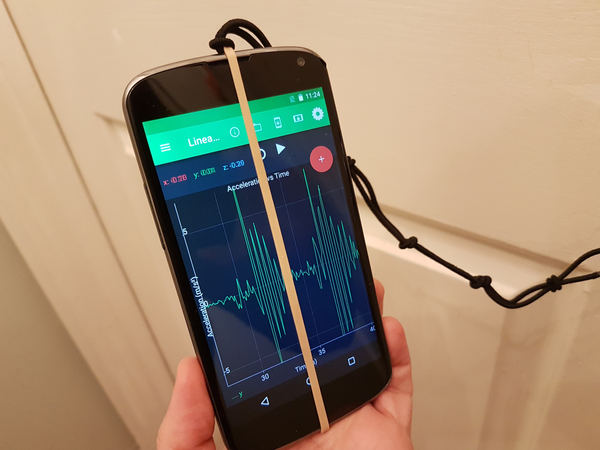
The acceleromter and proximeter sensors of a smartphone can be very helpful in studying periodic motion. The proximeter in pendulum mode with its running data table can be used to easily observe the relationship between frequency, period, length, mass, release angle, and acceleration due to gravity of a simple pendulum constructed out of a string with a bob (such as a ball of clay). Similarly, the accelerometer can be used to observe oscillations when attached to a series of thin rubber bands. Check out a number of related resources for teaching about these topics from our lessons page.
Have Physics Toolbox Apps been useful to you? We'd love to get your feedback on this quick 5-minute survey.
Have a great story to share about how you are using Physics Toolbox Apps? We'd love to feature you and your ideas in our newsletter or on our website! Drop us a message at any time to share your story.
Previous Newsletter Editions