Duplos, Soda, and Bulbs
Duplos, Soda, and Bulbs
Quick Lab Ideas on Social Media
from Bree Barnett Dreyfuss, Glen Gilchrist, & STEMteachersNYC
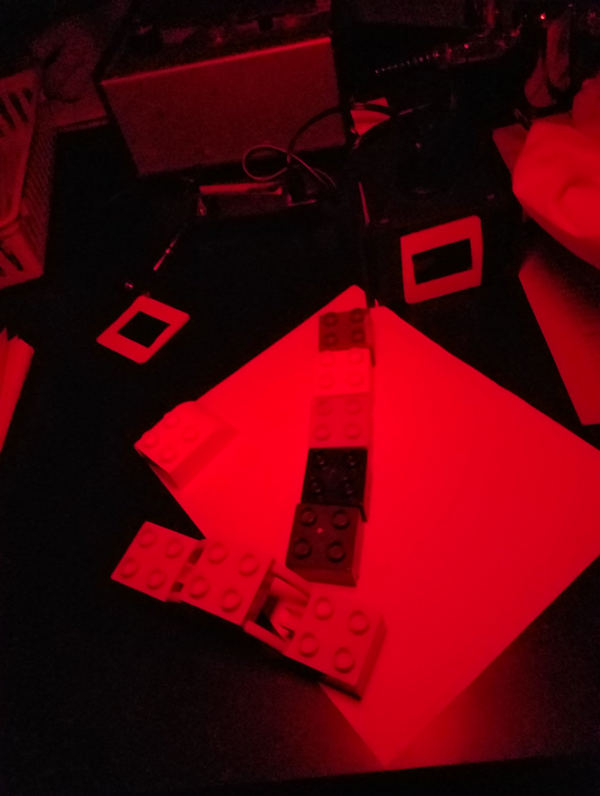
Teaching about color might have meant needing to go out and purchase either specialized colored LED lamps or covering bright lamps with theater gelatins. The day usually ended with most of my filters being sadly half-melted and mangled from the heat. Fortunately, LCD screens on mobile devices do a fantastic job of providing bright, monochromatic light.
Check out this blog posting from Bree Barnett Dreyfuss of California, U.S., who has some very clever ideas for using Duplos to teach about reflection (perhaps a better choice than using messy M&M candies, although far less tasty!).
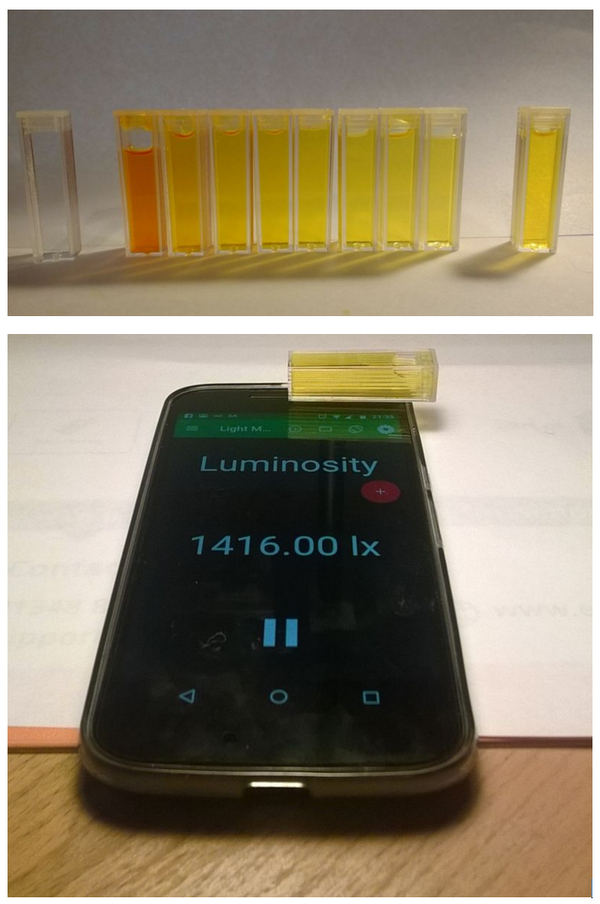
Although colorimeters can be used to measure concentrations (see Physics Toolbox Color Detector, not yet a part of Suite as it's not faully compatible with all devices), the same can be accomplished using the light meter. Students can even determine the Beer-Lambert law.
Glen Gilchrist, of the U.K., has an exceptionally detailed description of how to model the Beer-Lambert law using various concentrations of orange soda, preferrably using soda syrup.
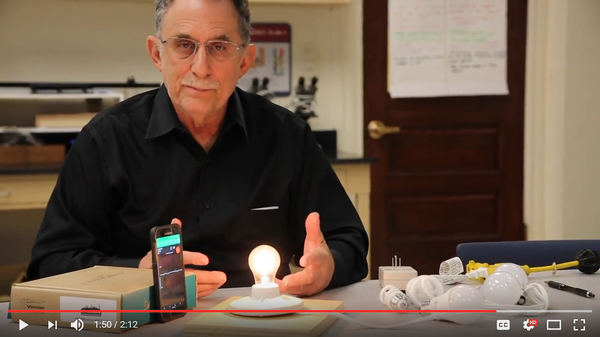
Back in December 2016, STEMteachersNYC of New York City put on a workshop dealing with energy. In the video below, they feature a sampling of their workshop, which included a study of the light intensity and energy efficiency of various types of bulbs. This activity can be accomplished with the light meter, and provides an objective measure of light intensity that cannot always be perceived by the eye. (In some cases, we actually perceive very bright intense as less intense then less intense objects because of the constriction of our pupils).
More Features
Available on Physics Toolbox Sensor Suite Pro
Logarithmic FFT
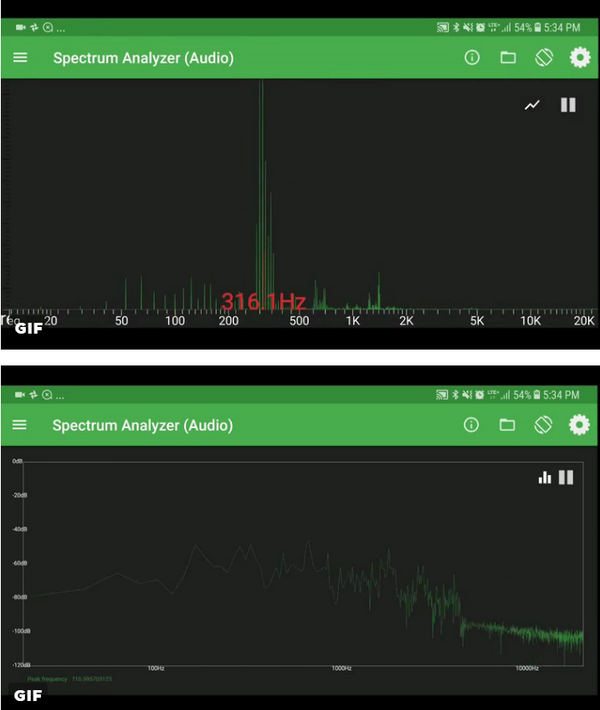
The oscilloscope setting now has a new option for Fast Fourier Transform (FFT) display. Previously it only showed Linear FFT, but a click of the button (near the pause symbol) will now display Logarithmic FFT. By converting the amplitude (y-axis) display from linear to logarithmic, it is possible to more easily observe less intense, but perhaps more important, sound frequencies. Check out this blog post from Reliability Web that gives an example of the benefits of each type of FFT for vibration analysis.
Kalman Filter
Currently available only for the g-Force Meter, a Kalman filter can now be automatically applied to data. This filter is useful when you are attemping to find the most stable, single value measurement (i.e. unlike a calibration, which is a one-time adjustment, a Kalman filter adjusts day so that the result centers around the best result -- it can be thought of as an "anchored average" that gets better over time). This is different from the Moving Average, which is most useful for smoothing - but not stabilizing - data curves by taking the average of a few data points before and after the interval before plotting.
For the University Educator
Example Undergraduate Theses Using Physics Toolbox


The end of the school year heralds a number of student theses using Physics Toolbox apps for primary research. Check out these most recent publications from around the globe:
Modeling Rail Vehicle Dynamic Load Variation and Bearing Wear, School of Mechanical and Mining Engineering, University of Queensland, Australia
Walking Movement Detection Using Stationary Stochastic Methods on Accelerometer Data, Faculty of Science, Center of Mathematical Sciences, Mathematical Statistics, Lund University, Sweden
Development and Evaluation of an Android App for the Dosage Measurement of Vibrations on Tractors (Spanish language), School of Engineering, University of Valladolid, Spain.
Have Physics Toolbox Apps been useful to you? We'd love to get your feedback on this quick 5-minute survey.
Have a great story to share about how you are using Physics Toolbox Apps? We'd love to feature you and your ideas in our newsletter or on our website! Drop us a message at any time to share your story.
Previous Newsletter Editions